Quick answer
An AI automation agency designs, builds and maintains workflows that connect your existing business tools to AI, so decisions and actions flow without constant manual effort. Unlike a simple software reseller or a “set and forget” vendor, a capable agency creates structured processes with human oversight, clear rules and continuous reporting. For UK small business owners, founders and operations managers, this guide For UK small business owners, founders and operations managers, the practical goal is to reduce repetitive work while keeping approval, governance and measurement in place. Acxiomflow helps teams move from scattered tools to one working process without replacing the software stack they already use.
An AI automation agency designs, builds and maintains workflows that connect your existing business tools to AI, so decisions and actions flow without constant manual effort. Unlike a simple software reseller or a “set and forget” vendor, a capable agency creates structured processes with human oversight, clear rules and continuous reporting. For UK small business owners, founders and operations managers, this guide explains exactly what to expect from a practical AI automation partner – from the first trigger event to the final approved output.
What an AI Automation Agency Really Does – and Doesn’t Do
The real job of an AI automation agency is to turn your scattered tools into one working process. It connects the apps you already use – your CRM, forms, email, documents, communication platforms – so that business events launch intelligent sequences that would otherwise need manual attention. The agency handles the architecture, the AI decision logic, the integration work and the ongoing maintenance, leaving you with a reliable, supervised system.
What an automation agency won’t do matters just as much. A reputable partner never delivers black‑box solutions where you lose visibility of how decisions are made. They don’t publish content, send client emails or change CRM records without a human checkpoint when needed. They won’t promise a fully autonomous operation where no one is accountable. Instead, they build workflows where you stay in control, review what matters and know exactly why something happened. This is the difference between tool installation and genuine AI workflow automation services.
The 5-Step AI Workflow Process Every UK Business Should Expect
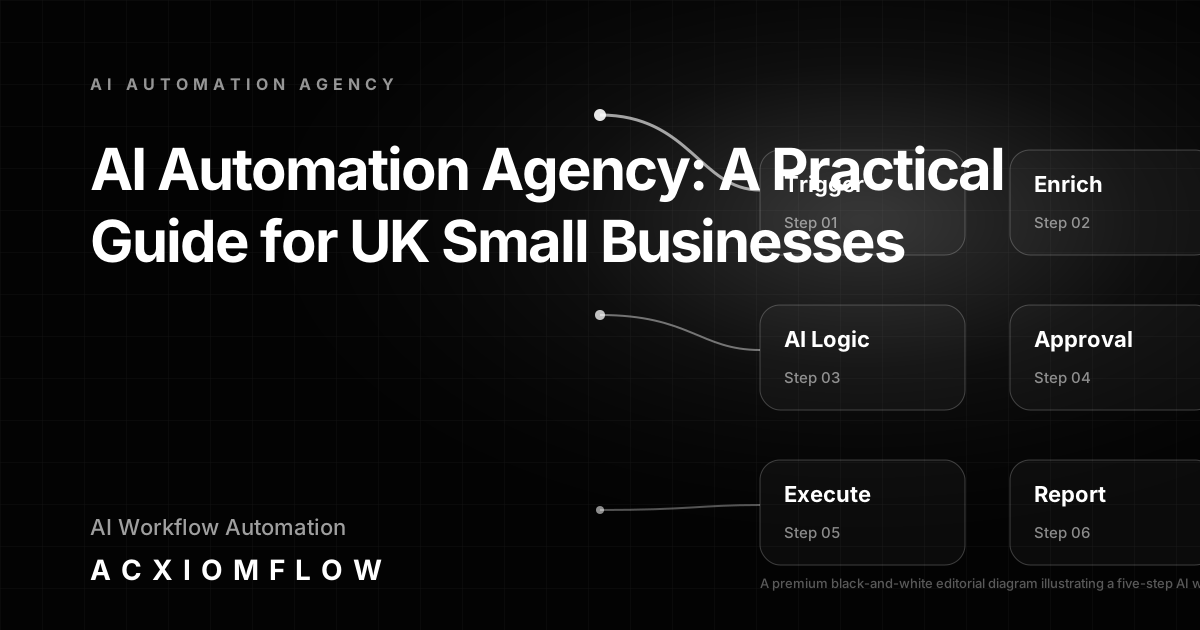
A well-built AI automation workflow follows a consistent pattern. Knowing these steps helps you evaluate any partner and understand how automation fits into a real business day.
Step 1: Trigger – where a business event starts the chain Everything begins with a concrete action: a prospect submits a form on your website, a new lead lands in your CRM, an invoice appears in your inbox, or a support ticket changes status. The trigger is always something measurable and owned by your existing systems – no magic, no unobserved background processes.
Step 2: AI decision logic – what the AI actually decides Once triggered, the workflow hands data to the AI layer. This might use a large language model (LLM), a classification model, or a rules engine, depending on the task. At this stage the AI doesn’t take final action; it enriches data, scores a lead, drafts a response, or suggests a next step. The output is a reasoned proposal that waits for the next stage.
Step 3: Human approval – the checkpoint that keeps you in control Before any irreversible action, the workflow pauses for a human review. For a lead qualification engine, that means an ops manager sees the AI score and the original enquiry before the lead moves forward. For a content workflow, a team member reviews the draft before publication. This checkpoint is not optional in a healthy automation design; it’s the place where judgment, brand tone and strategic context sit alongside AI speed.
Step 4: Output – delivering the result into your systems Once approved, the workflow completes the job: the CRM record updates, the email sends, the task is assigned, the report is generated. The output writes back into your real tools – HubSpot, GoHighLevel, Google Workspace, your project management board – without you copying data between tabs.
Step 5: Fallback and reporting – when things change, the workflow knows No workflow runs perfectly every time. A sound AI automation agency builds fallback paths: if an API is down, the system retries or alerts a human. If an approval doesn’t arrive within a set window, it escalates. At the same time, every run is logged and available in a dashboard, so you can see throughput, error rates and approval patterns. This combination of fallback handling and reporting closes the loop and makes continuous improvement possible.
When It’s the Right Time to Work with an AI Automation Agency
The hidden cost of scattered tools and manual workflows Many UK small businesses run on a collection of capable but disconnected applications. The team switches between CRMs, spreadsheets, email and message platforms, manually moving data and chasing approvals. The actual cost isn’t just the time lost – it’s the missed follow-ups, the data errors and the difficulty of seeing what’s really happening in the business. That’s the point where a thoughtful automation investment starts to earn its place.
Signs your operations are ready for structured AI automation You might be ready when repetitive, high-volume tasks eat into strategic work; when your existing tools don’t talk to each other and the handoffs are manual; or when you’re losing visibility because reporting depends on people remembering to update records. Readiness isn’t about being a tech company – it’s about having clear operational pain that a consistent, supervised process can relieve.
Typical UK business roles this fits Solo founders who handle marketing, sales and delivery all at once. Operations managers in growing service teams who need to standardise onboarding and lead routing. Agency directors who want proposal drafts and client reporting to run in the background, not on their weekends. In every case, the person is valuable for their judgment, not their data entry speed. AI workflow automation protects that judgment while freeing up time.
How Acxiomflow Builds One Working Process from Your Existing Tools
At Acxiomflow, we don’t ask you to rip out your software stack. We design automation systems that work with the tools you already use – CRM, email, forms, documents, telephony – and connect them through a clear, repeatable architecture. Our approach follows four phases: strategy, build, review and maintain. You can see the full Acxiomflow process behind every engagement.
Our service entities map directly onto real business outcomes:
- Social Media Automation Engine – converts content plans into scheduled, reviewable posts without daily manual effort.
- AI SEO Autopilot – researches, drafts and optimises content, with human editorial oversight at each stage.
- Lead Generation Engine – scores and routes inbound enquiries so sales conversations happen faster, not at random.
- Automated Intelligence Portal – brings reporting and decision support into one dashboard, not five spreadsheets.
Under the hood, we orchestrate workflows with n8n, Make, APIs and the right LLMs for each job – but we don’t make tool choice the headline. The real value lies in the process architecture: how triggers are defined, where AI is allowed to contribute, where a human must approve, and what happens when something doesn’t go as planned. That’s the engineering that turns scattered tools into one calm, working system.
Real AI Workflow Examples Built for UK Service Businesses
The best way to understand an AI automation agency is through practical workflows. Below are three examples that follow the trigger → AI decision → human approval → output → fallback pattern. Each example is typical for service businesses, agencies and consultancies in the UK.
Lead qualification engine Trigger: A prospect completes a “Get a Quote” form on your website. AI decision logic: The workflow enriches the submission with public company data, scores the lead against criteria you’ve set (industry, size, urgency signals), and drafts a brief summary. Human approval: An ops manager reviews the score and the raw enquiry in a simple dashboard, then confirms correct routing. Output: The lead is created or updated in the CRM with the AI summary attached, and a notification goes to the right salesperson. Fallback/reporting: If enrichment data is incomplete, the lead still routes but is flagged for manual research. All activity is logged in a weekly pipeline report.
Proposal generation Trigger: A client brief arrives by email or a shared folder. AI decision logic: The system extracts key requirements, references your service catalogue and drafting style, and generates a first proposal draft in your branded template. Human approval: A consultant reviews the draft, adjusts pricing or scope, and confirms the final version. Output: A branded PDF is created and a secure tracking link is emailed to the client. Fallback/reporting: If the AI confidence on scope extraction is low, the draft is marked “needs deeper review”. The reporting dashboard tracks draft-to-send time and approval cycles.
Customer onboarding Trigger: A new client signs a contract or completes payment. AI decision logic: The workflow reads the service agreement, generates a tailored onboarding checklist, and assigns tasks to team members based on availability and skill set. Human approval: The project lead reviews the task assignments before they go live. Output: Tasks appear in your project management tool, and the client receives a personalised welcome sequence with clear next steps. Fallback/reporting: Late tasks automatically escalate, and the onboarding dashboard shows completion rates and bottlenecks.
Explore more AI workflow automation examples to see how these patterns apply to your day-to-day operations.
What to Look for in an AI Automation Partner (UK-Specific Checklist)
When you evaluate an AI automation agency, a few criteria separate a genuine operational partner from a tool-vendor with buzzwords.
Process-first, not tool-first Agencies that lead with a list of apps are selling integration hours. A process-first partner starts with your business triggers, decision points and approval needs, then selects the simplest tool chain to deliver that. Ask to see a workflow map before anyone mentions a specific platform.
Questions about human oversight and data handling - Where exactly does the human review fit into the proposed workflow? - How are approval windows and escalation handled? - Is the design compliant with UK GDPR, including data residency, consent handling and the right to human review of automated decisions where applicable?
What a healthy maintenance relationship looks like A good automation partner provides ongoing monitoring, not a one-off delivery. They should be able to show you a reporting interface that tracks workflow health, error rates and throughput, and they should propose regular review cycles to refine decision thresholds as your business changes.
FAQs: AI Automation Agency Questions from UK Business Owners
Before scheduling a conversation, many small business owners have the same practical questions. You can also visit our AI workflow automation FAQs for quick answers to common queries.
What do AI automation agencies do? An AI automation agency designs, builds, deploys and maintains workflows that connect your existing business tools to AI. Instead of selling you software, they create sequences where a real business event (a form submission, an email, a new CRM record) triggers a series of actions – some handled by AI, some by human checkpoints – until a complete output is delivered, like a qualified lead update, a draft proposal or a published report. The agency ensures the process runs reliably, with clear fallbacks when something unexpected happens.
How much does an AI automation agency cost? Cost varies based on workflow complexity, the number of integrations and the level of ongoing support. Many UK agencies begin with a discovery or audit phase, then propose a fixed-price build or a monthly retainer covering maintenance and iterative improvements. Transparent pricing emerges once your specific operational needs are understood; the value drivers are hours saved, error reduction and faster cycle times, not a single headline figure.
Is an AI automation agency worth it for a small business? Worth is determined by how much time and operational clarity you gain. If manual, repetitive tasks are eating into strategic work, or if your existing tools don’t talk to each other, an AI automation agency can design a process that turns those scattered apps into a single, cohesive machine. For many UK small businesses, the return comes from freeing up founder or manager time, not from massive revenue spikes.
What is the best AI agent for automation? There is no single “best” AI agent. The right model depends on the specific job: some are better at natural language understanding, others at decision trees, and others at connecting to specific APIs. A competent agency matches AI models and decision logic to each workflow step, explaining why a particular model suits that moment and where a simple rule is more reliable than AI.
What tools do UK AI automation agencies typically use? Common stacks include workflow builders like n8n, Make or Zapier; CRM and communication platforms such as GoHighLevel, HubSpot or Salesforce; large language models from OpenAI, Anthropic or open-source options; and cloud storage, document and telephony APIs. The toolset is secondary to how these are woven together into stable, GDPR-compliant workflows.
How long does it take to see results from an AI automation project? For a single, well-defined workflow like lead qualification, a first working version can often be built and tested within a few weeks. More interconnected workflows or those requiring custom AI training follow an iterative cycle: an initial build, a period of monitoring, and then fine-tuning. The most important milestone isn’t the first deployment but the point at which the workflow runs reliably and the human-approval touchpoints become predictable.
Next Step: Book a Free AI Workflow Audit (No Tool Shopping)
If your UK small business feels stretched across scattered tools and repetitive manual steps, the next practical move is a conversation about your actual operational flow – not a generic tool demo. At Acxiomflow, we work with your existing software and design a clear process from trigger to approved output, with human oversight and reporting built in.
Book a free AI workflow audit and we’ll walk through where your current setup has friction, what a structured automation layer would change, and how to get there without replacing the stack you already rely on.